
By Frans Lucas
The Night of August 28, 1944
Engelen in the evening around 11 p.m. must have been very quiet, as in England a four-engined Halifax departed for her mission. A mission that would unintentially end in a polder near Engelen.
The Halifax took off from Tempsford, an airfield about 100 km North of London serving as a support for the resistance in Europe.
The sorties were veiled in secrecy, as was this one to the occupied Netherlands. Besides the seven crew members, it held three Dutch secret agents who, after being dropped, were commissioned to organize one or more resistance groups and then keep contact with London.
This RAF flight was commissioned by the Bureau of Special Missions (Bureau Bijzondere Opdrachten). This Dutch Bureau’s task was to organize and support the resistance in the Netherlands, also to gather intelligence and make preparations to take over management as soon as the Germans had been dislodged. It was this Bureau that sent the secret agents to the occupied area.
The Bureau was totally dependent upon the RAF. They were the sole providers with excellent materials and specially trained crews. In this case, the seven member crew on board the four-engined Halifax.
The three agents on board were: Jacky van der Meer, organizer (mission ‘Stalking’), Krijn Buitendijk, sabotage instructor (mission ‘Fishing’), and Gerrit Kroon, telegrapher (mission ‘Skating’).The agents were dropped on the Hendrik field near Deurne, after which they had to report to Baron De Smet at the castle of Deurne. Their password : “We are here to pick up the buckwheat harvest”. The resistance was informed through Radio Orange which had sent out the message “Still waters have deep puddles”.
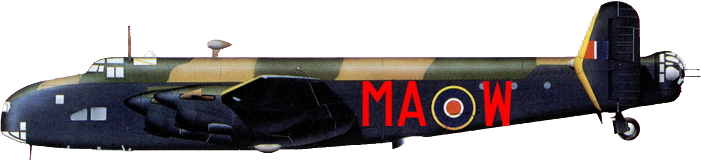
The Halifax LL388, with ‘MA-W’ in large letters on its side, lifted off at 9:50 p.m. local time.
On board were:
1. P. Green, pilot
2. N. Slade, navigator
3. G. Dugdale, radio operator
4. N. Huntley, flight engineer
5. A. Dean, bomb aimer
6. C. Carter, rear gunner|
7. N. Hayward, dispatcher
In the rear of the aircraft were Gerrit Kroon, Jacky van der Meer and Krijn Buitendijk.
Graham Dugdale, the wireless oprarator told this story:
The display of searchlights and flak seemed even greater than it had been the last time. We were weaving far off course, trying to avoid the blinding lights and almost continual streams of flak. The ride was rough indeed and I couldn’t see much chance of dropping anything in the general area, but time was passing and if we were to have any chance of delivering our cargo we had to be ready although the enemy activity seemed just too much. Hoping that by the time we got to the target it would be quiet enough to drop our supplies; I made my way back to my position for dropping the crates through the double doors. Glancing through a side window I saw, in the full flood of diffused searchlight beams, a church steeple go sailing by above us on the starboard side.
I stood behind the deep step in the aircraft floor, where the root of the wings slot into the fuselage. We flew along at low level, twisting and turning for several more minutes, vainly trying to escape the glaring searchlights.
In one instant it was over, the resounding crash of a cannon shell exploding in the nose of the aircraft and that was it. We dropped the few feet to the ground and tobogganed over a couple of fields. Things happened so fast that it was impossible to remember the sequence, I was thrown on my back, my feet slamming against the deep step behind the main beam, we skidded across the field and I bounced up and down on the floor a few times until finally it stopped and all was quiet.
